How Does Theory of Change Work?
TOC maps out your initiative through 6 stages:
- Identifying long-term goals
- Backwards mapping and connecting the preconditions or requirements necessary to achieve that goal and explaining why these preconditions are necessary and sufficient.
- Identifying your basic assumptions about the context.
- Identifying the interventions that your initiative will perform to create your desired change.
- Developing indicators to measure your outcomes to assess the performance of your initiative.
- Writing a narrative to explain the logic of your initiative.
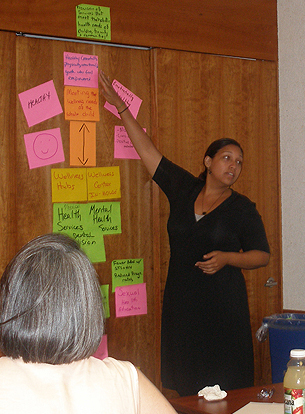 The TOC process hinges upon defining all of the necessary and sufficient conditions required to bring about a given long term outcome. TOC uses backwards mapping requiring planners to think in backwards steps from the long-term goal to the intermediate and then early-term changes that would be required to cause the desired change. This creates a set of connected outcomes known as a “pathway of change”. A “pathway of change” graphically represents the change process as it is understood by the initiative planners and is the skeleton around which the other elements of the theory are developed.
During the process of creating the pathway of change, participants are required to articulate as many of their assumptions about the change process as they can so that they can be examined and even tested to determine if any key assumptions are hard to support (or even false). There are typically three important types of assumptions to consider: (a) assertions about the connections between long term, intermediate and early outcomes on the map; (b) substantiation for the claim that all of the important preconditions for success have been identified; and (c) justifications supporting the links between program activities and the outcomes they are expected to produce. A fourth type of assumption which outlines the contextual or environmental factors that will support or hinder progress toward the realization of outcomes in the pathway of change is often an additional important factor in illustrating the complete theory of change.
TOC approach to planning is designed to encourage very clearly defined outcomes at every step of the change process. Users are required to specify a number of details about the nature of the desired change — including specifics about the target population, the amount of change required to signal success, and the timeframe over which such change is expected to occur. This attention to detail often helps both funders and grantees reassess the feasibility of reaching goals that may have initially been vaguely defined, and in the end, promotes the development of reasonable long-term outcome targets that are acceptable to all parties.